
Choosing the right textile printing materials supplier is an important decision for garment manufacturers, textile printing factories, fabric coating companies, and international distributors. The materials used in production influence print appearance, fabric feel, adhesion, durability, process compatibility, and the consistency of finished products. A supplier that understands these requirements can help buyers make more informed purchasing decisions and establish a more stable production workflow.
Today’s textile industry serves a wide range of applications, from fashion garments and sportswear to shoes, luggage, umbrellas, bedding, and decorative fabrics. Each application may require a different combination of printing materials, surface treatments, and production processes. As a result, buyers need to evaluate more than the quoted unit price when comparing suppliers.
For importers, wholesalers, and textile chemical distributors, the challenge is to identify a partner that can provide suitable product options, dependable communication, and support for changing customer requirements. This guide explains what to consider when selecting a textile printing materials supplier and how to build a sourcing strategy around your actual production needs.
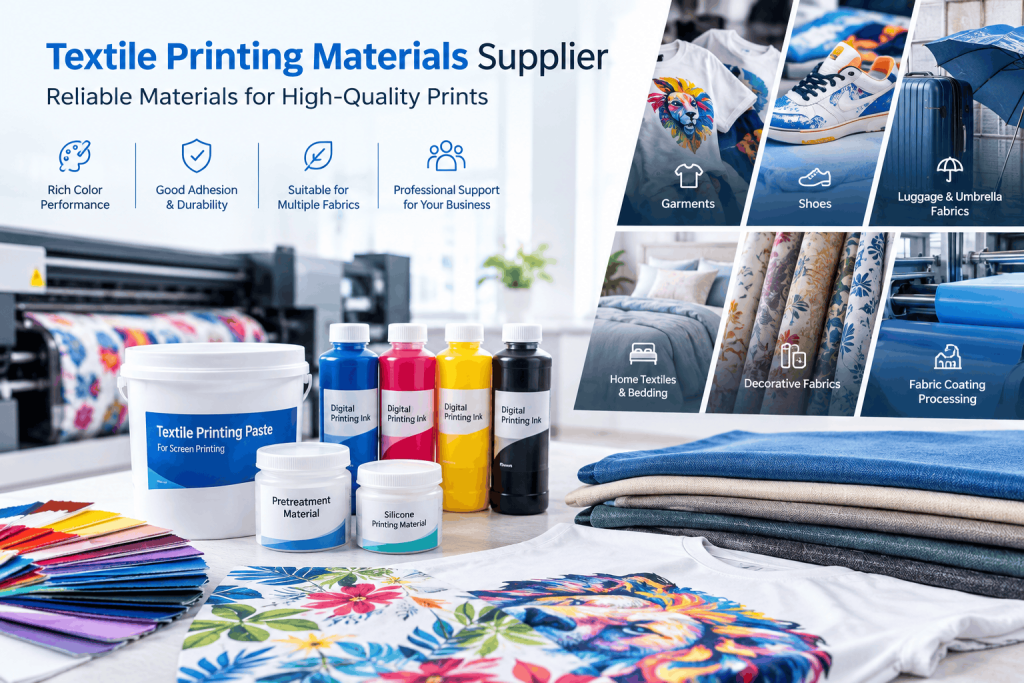
1. What Does a Textile Printing Materials Supplier Provide?
A textile printing materials supplier provides the inks, pastes, coatings, and related materials used to create patterns, colors, textures, or functional finishes on textile surfaces. Depending on its product portfolio, a supplier may support conventional screen printing, digital textile printing, garment decoration, and specialized printing applications.
Common product categories include printing paste, digital printing ink, digital pretreatment materials, silicone-based printing materials, and application-specific solutions. These products serve different purposes and should be selected according to the printing method, substrate, equipment, and required finish.
For example, screen printing paste is commonly associated with stencil-based printing processes, while digital printing ink is used with compatible inkjet systems. Pretreatment and coating materials may also be needed to prepare fabric surfaces or improve their interaction with printing materials.
A professional supplier should help buyers understand these distinctions rather than recommending the same material for every application.
Why Product Range Matters to B2B Buyers
Manufacturers often produce several types of finished products for different markets. A garment factory may handle cotton T-shirts, polyester sportswear, and customized promotional apparel. A textile converter may work with luggage fabric, umbrella material, and decorative textiles.
A supplier with relevant product categories can give buyers more options when evaluating different production requirements. However, a broad catalog alone is not enough. Buyers should confirm that the proposed products are suitable for their specific materials and processing conditions.
Explore Caigle’s textile printing materials and product range to understand its focus on printing paste, digital printing materials, silicone products, and shoe material applications.
2. Evaluate the Textile Printing Materials Supplier by Application
One of the most effective ways to compare suppliers is to begin with the finished product rather than a generic chemical specification. The intended application determines which performance characteristics deserve the most attention.
Garment and Apparel Printing
Garment manufacturers may prioritize color appearance, print definition, softness, stretch compatibility, and resistance to washing and rubbing. The relative importance of these properties depends on the garment type and its end use.
A casual T-shirt, for instance, may require a different surface feel from a high-stretch sportswear garment. Thick graphics, fine details, and large printed areas can also create different material requirements.
When assessing a textile printing materials supplier, provide details about the fabric composition, garment construction, print design, and expected care conditions. These details help the supplier identify suitable candidates for sample testing.
Shoe Materials, Luggage, and Umbrella Fabrics
Shoe uppers, luggage fabrics, and umbrella materials may differ significantly in surface structure, flexibility, coating, and intended exposure. A material that performs well on one substrate should not automatically be assumed to work equally well on another.
For these applications, buyers should discuss substrate adhesion, abrasion exposure, flexibility, surface appearance, and relevant finishing requirements. Where the substrate has already been coated or treated, its existing finish should also be considered.
Ask the supplier to confirm compatibility with the actual material and recommend an appropriate evaluation procedure before production approval.
Bedding and Decorative Fabrics
Home textiles and decorative fabrics often involve large printed areas, repeated patterns, and products intended for regular handling or washing. Consistency across production batches can therefore be particularly important.
A buyer sourcing materials for bedding may need to consider fabric softness, color consistency, print coverage, and the care requirements of the finished product. Decorative fabrics may place greater emphasis on visual effects, surface texture, or coordination with the overall design.
A suitable supplier should understand the final application and help define practical acceptance criteria before a bulk order is placed.
For a closer look at these industry applications, visit Caigle’s textile printing applications page.
3. Match Printing Materials to the Production Process
A textile printing materials supplier should be able to discuss the production process in which its products will be used. Material selection should account for the complete workflow, not simply the name of the product.
Screen Printing and Printing Paste
Screen printing uses a prepared screen to transfer printing material onto a substrate. Depending on the design and desired result, production may involve multiple colors, different print layers, or special surface effects.
When selecting printing paste, buyers should discuss print definition, application method, substrate compatibility, desired hand feel, elasticity, and curing conditions. The number of print passes and the selected screen setup may also influence the final result.
Manufacturers should not assume that changing the paste alone will solve every printing problem. Screen preparation, application technique, drying, curing, and fabric characteristics can all affect the outcome.
Digital Textile Printing
Digital textile printing uses compatible printing equipment to reproduce designs directly from digital artwork. It can support detailed patterns, variable designs, and production workflows where flexibility is important.
However, digital printing performance depends on the relationship between ink, printhead, fabric, pretreatment, machine settings, and drying or curing conditions. Ink compatibility should therefore be confirmed with the equipment and substrate used by the factory.
Some workflows may require pretreatment or additional coating materials. Buyers should ask which products are necessary for their process and whether the supplier can provide technical guidance for evaluating the complete system.
Silicone and Specialized Printing Materials
Silicone-based materials may be considered for applications requiring particular surface effects, flexibility, or functional characteristics. Specialized printing pastes may also be used to create distinctive textures or visual finishes.
The correct choice depends on the intended application and the performance requirements of the finished item. Before approving a material, confirm the processing conditions and evaluate the finished print on the actual substrate.
Review the available categories in Caigle’s product range, then discuss the most relevant options with its technical team.
4. Key Criteria for Choosing a Reliable Textile Printing Materials Supplier
Product suitability is essential, but long-term purchasing decisions should also consider the supplier’s ability to support consistent manufacturing and international business.
Product Consistency and Quality Control
Differences between batches can create production challenges, including changes in application behavior, print appearance, or finished-product performance. Buyers should ask how the supplier manages production quality and whether it can provide relevant documentation for the products being considered.
Where appropriate, establish agreed sample standards, inspection criteria, and procedures for handling quality concerns. These measures help both parties understand what is expected before regular orders begin.
Do not rely solely on a supplier’s general quality claims. Request evidence relevant to the product and intended application.
Technical Communication and Application Support
Clear communication can reduce the time required to resolve material selection and production issues. A capable supplier should be able to discuss substrate characteristics, equipment compatibility, application methods, and process limitations.
For international buyers, communication should also cover product identification, technical documents, packaging requirements, and the information needed to reproduce approved production results.
Before placing a substantial order, assess how clearly the supplier answers technical questions and whether its recommendations reflect your actual manufacturing conditions.
Production Capacity and Supply Planning
Importers, distributors, and large factories need to consider whether a supplier can support their expected purchasing volumes and delivery schedules. Production capacity is only one part of the assessment; order planning, lead-time communication, packaging, and replenishment arrangements also matter.
Share your estimated demand, order frequency, destination market, and seasonal requirements when requesting a quotation. This allows both parties to discuss realistic supply arrangements instead of relying on assumptions.
Compliance Documentation and Market Requirements
Different destination markets, customers, and product categories may impose different chemical management or product documentation requirements. Buyers should identify these requirements before finalizing a sourcing decision.
Ask which declarations, test reports, safety data sheets, or certifications are available for the specific product under consideration. Verify their scope and validity where applicable, and do not assume that documentation for one product automatically covers an entire product range.
A textile printing materials supplier should be able to clarify what documentation it can provide and what additional verification may be necessary.
5. How to Test Textile Printing Materials Before Bulk Purchasing
Sample evaluation is an important step in reducing sourcing risk. Even when a product appears suitable on paper, its actual performance may change with the fabric, equipment, application method, or curing conditions.
A structured testing process can help buyers compare suppliers more objectively.
Step 1: Define the application. Identify the fabric composition, surface treatment, printing method, target appearance, and intended end use.
Step 2: Request suitable samples. Provide the supplier with the information needed to recommend candidate materials. Where necessary, request relevant technical documentation before testing.
Step 3: Test under realistic conditions. Use the actual substrate and, as far as practical, the production equipment and process settings intended for manufacturing.
Step 4: Evaluate the finished result. Assess the properties that matter for the application, which may include color appearance, adhesion, flexibility, surface feel, washing performance, or abrasion resistance.
Step 5: Record the approved process. Document the selected material, application conditions, curing settings, and inspection results. These records can support future production and supplier comparisons.
Step 6: Confirm expectations before ordering. Agree on product identification, order quantity, packaging, delivery schedule, and quality acceptance criteria.
This approach helps manufacturers make decisions based on actual results instead of price or marketing claims alone.
6. Why Work with Caigle as Your Textile Printing Materials Supplier?
For businesses sourcing textile printing materials, a supplier’s product portfolio and understanding of different applications can be valuable starting points.
Guangdong Caigle Science & Technology Co., Ltd. focuses on textile printing materials and related solutions. Its website presents product categories covering printing paste, digital coating ink, silicone materials, and shoe materials, serving applications such as garments, shoes, luggage, umbrellas, bedding, and decorative fabrics.
This range is relevant to B2B customers whose sourcing requirements extend across multiple textile products or printing processes. Rather than selecting materials solely by category name, buyers can discuss their substrates, production methods, and target results to identify suitable products for evaluation.
Caigle also provides an applications overview that helps buyers explore the relationship between its material categories and common industry uses.
For overseas importers and distributors, the next step is to communicate specific market needs, expected order volumes, product documentation requirements, and delivery expectations. These details allow a sourcing discussion to focus on practical fit instead of broad product claims.
No single material is suitable for every fabric or production line. The most useful supplier relationship is one built around clear technical information, sample validation, and consistent expectations.
7. Common Mistakes to Avoid When Sourcing Textile Printing Materials
Even experienced buyers can encounter sourcing problems when material selection is based on incomplete information.
Choosing only by price. A lower unit price may not represent the best overall value if the material creates additional process adjustments, quality issues, or waste. Compare the total production impact as well as the quotation.
Ignoring fabric compatibility. Different fibers, coatings, and surface treatments can affect how printing materials behave. Always validate the product on the intended substrate.
Skipping sample tests. Product descriptions cannot replace practical testing. Approve samples under conditions that reflect the intended production process.
Overlooking documentation. Confirm the documents required by your business, customers, and destination market before ordering.
Failing to define quality expectations. Terms such as “good adhesion” or “soft hand feel” can be interpreted differently. Use agreed test methods and acceptance criteria whenever possible.
Providing incomplete inquiries. A request containing only a product name may not give a supplier enough information to recommend the right solution. Include the application, substrate, process, expected volume, and target performance.
Avoiding these mistakes can help factories, wholesalers, and importers develop a more reliable sourcing process.
Conclusion: Choose a Textile Printing Materials Supplier for Long-Term Value
Selecting a textile printing materials supplier requires more than comparing product prices. Buyers should evaluate material compatibility, application requirements, production consistency, technical communication, documentation, and supply planning.
For garment factories, screen printing companies, digital printing businesses, shoe material producers, fabric coating processors, and textile chemical distributors, the best starting point is a clear understanding of the finished product and the manufacturing process.
Sample testing and agreed acceptance criteria can then help determine whether a material is appropriate for regular production. By working with a supplier that understands its product categories and can discuss application-specific requirements, businesses can make more informed purchasing decisions and build stronger supply relationships.
If you are looking for textile printing materials for garments, shoes, luggage, umbrellas, bedding, or decorative fabrics, contact Caigle to discuss your application, substrate, printing process, and sourcing requirements. Share your project details to help the team identify relevant product options for evaluation.
Visit the official Caigle website to explore its product portfolio and begin your inquiry.
FAQ: Textile Printing Materials Supplier
1. What should I look for in a textile printing materials supplier?
Look for relevant product categories, documented quality procedures, technical communication, application knowledge, and supply arrangements that match your needs. Confirm product suitability through sample testing before bulk purchasing.
2. Can one supplier support both screen printing and digital textile printing?
Some suppliers offer materials for multiple printing processes. However, product availability and compatibility vary. Ask for the specific products intended for your equipment, substrate, and application rather than assuming that all materials are interchangeable.
3. How do I choose printing materials for different fabrics?
Start with the fiber composition, surface treatment, printing method, and final product requirements. Then request suitable samples and evaluate the finished print under realistic production conditions.
4. What information should I include in a B2B quotation request?
Include your company type, intended application, substrate, printing process, target performance, estimated order quantity, destination market, and documentation requirements. Providing this information helps the supplier prepare a more relevant response.
5. Why should textile printing materials be tested before a bulk order?
Testing helps verify compatibility with the actual fabric and production process. It can reveal potential issues with print appearance, adhesion, flexibility, or durability before a larger order creates greater commercial risk.
6. How can I contact Caigle about textile printing materials?
Visit Caigle’s official website to review its product categories and use the contact options provided on the site. Include your application details and purchasing requirements to make the inquiry more specific.