
Choosing the right textile printing method can directly affect product quality, production efficiency and manufacturing costs. For garment factories, textile printing companies, fabric processors and printing material suppliers, Screen Printing vs. Digital Textile Printing is an important comparison when planning production. Both methods are widely used in textile decoration, but they differ in printing technology, material requirements, preparation procedures and suitable applications.
Understanding Screen Printing vs. Digital Textile Printing helps manufacturers select a process according to fabric composition, order quantity, artwork complexity and expected print performance. Screen printing is often considered for repeat designs, established production workflows and special surface effects. Digital textile printing is attractive for customized designs, detailed images and flexible production schedules.
However, neither method is automatically better for every project. A practical evaluation of Screen Printing vs. Digital Textile Printing should include the complete workflow, from artwork preparation and material selection to drying, curing and final inspection. This guide explains the main differences and provides suggestions for choosing suitable printing materials.
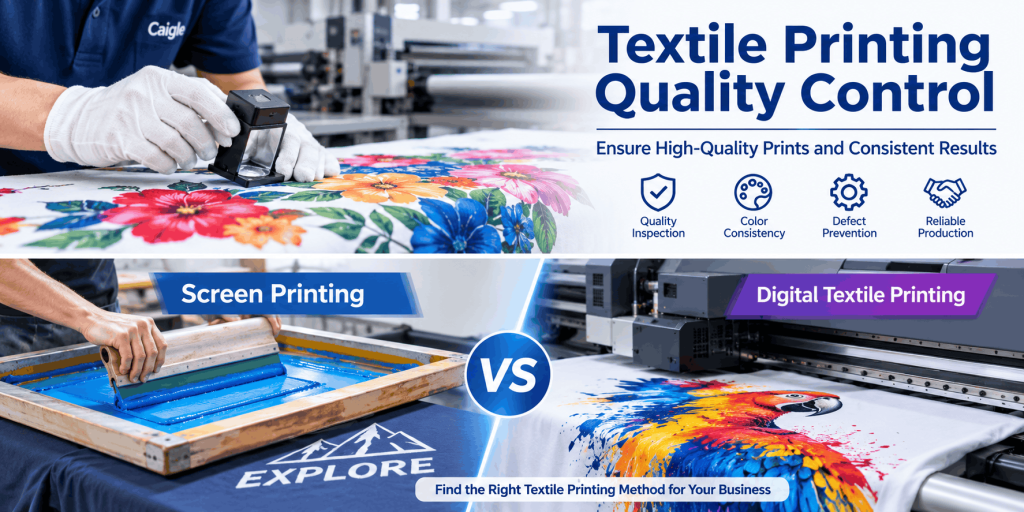
1. Understanding Screen Printing vs. Digital Textile Printing
Before comparing costs and applications, manufacturers should understand how the two printing methods work.
Screen printing transfers printing paste or ink onto fabric through a mesh screen. A stencil determines which areas allow the printing material to pass through. Different colors generally require separate screens, making preparation an important part of the production process.
Digital textile printing transfers artwork using digital printing equipment. The design is processed through software and sent to the printer, which applies ink according to the digital image. Depending on the technology, printing may be performed directly onto a garment or through a transfer process.
The basic distinction in Screen Printing vs. Digital Textile Printing is therefore the method of transferring the design. Screen printing relies on prepared screens, while digital printing relies on digital files, compatible inks and printing equipment.
Both processes require careful control of fabric quality, printing materials and finishing conditions. A suitable printing method should be selected according to the final product rather than general assumptions about technology.
2. How Does the Screen Printing Process Work?
Screen printing is a traditional textile printing method used for garments, sportswear, bags, footwear materials and decorative fabrics. It is particularly relevant when manufacturers need to reproduce the same design across repeated production runs.
In the Screen Printing vs. Digital Textile Printing comparison, screen printing involves more physical preparation before printing, but the prepared screens can be used for repeat production when their condition remains suitable.
Main Steps in Screen Printing
A typical screen printing process includes the following stages:
- Artwork preparation: The design is separated into individual colors when required.
- Screen preparation: A mesh screen and stencil are prepared for each color or printing layer.
- Printing material selection: Printing paste is selected according to the fabric, desired appearance and process.
- Printing operation: A squeegee pushes printing paste through the open areas of the screen.
- Drying and curing: The printed textile receives the treatment required by the selected formulation.
- Quality inspection: Operators examine color consistency, pattern definition, adhesion and surface appearance.
Each stage can influence the final result. Screen mesh, paste viscosity, printing pressure, screen alignment and fabric characteristics should be controlled throughout production.
Advantages of Screen Printing
Screen printing offers several advantages in textile manufacturing:
- Repeat production: Prepared screens can support repeated printing of the same artwork.
- Material flexibility: Different printing pastes can be selected for different fabrics and surface effects.
- Special finishes: Suitable formulations may create raised, glossy, textured or other decorative appearances.
- Established workflows: Many textile factories already have screen printing equipment and experienced operators.
- Process control: Consistent screens, materials and operating conditions can help maintain repeatable results.
These advantages make screen printing a practical option for repeat garment graphics, logos and decorative patterns. When evaluating Screen Printing vs. Digital Textile Printing, manufacturers should consider whether these production characteristics match their order structure.
3. How Does Digital Textile Printing Work?
Digital textile printing uses digital files and specialized printing equipment to reproduce designs on textiles. Unlike traditional screen printing, it does not normally require a separate physical screen for every design.
This makes digital textile printing useful for manufacturers handling frequent artwork changes, customized orders and complex images. In the Screen Printing vs. Digital Textile Printing comparison, digital printing is often selected when flexibility and detailed image reproduction are important.
Main Types of Digital Textile Printing
Two common digital printing technologies are DTG and DTF.
Direct-to-Garment (DTG) printing applies ink directly onto a garment. Fabric preparation and pretreatment may be required, depending on the garment, ink and equipment.
Direct-to-Film (DTF) printing transfers a design from a printed film onto the textile. The process typically involves printing onto transfer film, applying adhesive powder, curing and transferring the design.
Although both are digital methods, their materials and production procedures are different. Manufacturers should not assume that DTG ink, DTF ink and other digital printing materials are interchangeable.
Advantages of Digital Textile Printing
Digital textile printing provides several production benefits:
- Flexible artwork changes: Digital files can be modified without preparing a new screen for every design.
- Detailed graphics: Digital systems can reproduce complex patterns, fine details and color gradients.
- Customization: Different products can carry different designs within the same order.
- Reduced screen preparation: Suitable orders can avoid the screen-making stage.
- Small-run flexibility: Digital printing may be practical for samples, personalized products and limited quantities.
When comparing Screen Printing vs. Digital Textile Printing, these advantages are especially relevant to manufacturers serving customers who frequently update designs or require customized products.
Digital printing still requires suitable ink, compatible equipment, fabric preparation and controlled finishing. Its actual performance depends on the complete production system.
4. Screen Printing vs. Digital Textile Printing: 7 Key Differences
A meaningful comparison of Screen Printing vs. Digital Textile Printing should cover more than the printing machine. The following seven factors can help manufacturers make a more informed decision.
4.1 Printing Preparation
Screen printing requires physical screen preparation and, for multicolor designs, color separation and registration. This preparation takes time, especially when artwork changes frequently.
Digital textile printing usually requires digital artwork preparation, color management and printer setup. It can simplify the transition between different designs.
For repeated orders, screen preparation may be worthwhile. For orders involving many different designs, digital printing may offer greater flexibility.
4.2 Design Complexity
Screen printing can produce clear graphics, strong color areas and specialty effects. Complex multicolor artwork may require more screens and careful registration.
Digital textile printing is often suitable for photographs, gradients, fine lines and detailed artwork. It allows manufacturers to change digital designs without making a new screen for each pattern.
This difference is one of the most important considerations in Screen Printing vs. Digital Textile Printing. Manufacturers should compare actual samples when color accuracy and fine detail are critical.
4.3 Production Quantity
Screen printing is frequently considered for repeat production because the initial screen preparation can be distributed across a larger quantity.
Digital textile printing may be more convenient for small batches, personalized orders and collections containing many different patterns. However, machine speed and finishing capacity still determine how efficiently an order can be completed.
The best choice depends on the actual order quantity, number of designs and production schedule.
4.4 Fabric Compatibility
Cotton, polyester, nylon, blended fabrics and elastic textiles have different surface characteristics. Their composition and construction can influence printing behavior, adhesion and final appearance.
Screen printing paste should be selected according to the fabric and intended effect. Digital printing ink must match the printer, printhead and textile application.
In Screen Printing vs. Digital Textile Printing, fabric compatibility should be tested rather than assumed. A material that performs well on one textile may not produce the same result on another.
4.5 Surface Feel and Decorative Effects
Screen printing offers flexibility for creating different surface appearances. Depending on the formulation, manufacturers may produce raised graphics, glossy finishes, textured patterns and other decorative effects.
Digital textile printing is often chosen for image detail and artwork flexibility. Additional coating or finishing materials may be used when a particular surface appearance is required.
When comparing Screen Printing vs. Digital Textile Printing, manufacturers should consider the expected hand feel and appearance of the finished product, not just the printed image.
4.6 Production Cost
Screen printing costs include screen preparation, printing paste, labor, setup, cleaning, drying and curing. These costs should be evaluated against the production quantity.
Digital printing costs include ink consumption, equipment operation, pretreatment where required, machine maintenance and finishing. The cost also depends on image coverage and production speed.
Neither process is always cheaper. A complete comparison of Screen Printing vs. Digital Textile Printing should calculate the cost per finished and inspected product.
4.7 Production Flexibility
Screen printing is suitable for stable designs and established production plans. Frequent changes may require additional screen preparation and adjustment.
Digital textile printing makes it easier to change artwork and produce different patterns within one order. This can be useful for fashion collections, customized garments and short-run products.
The choice depends on whether the factory prioritizes repeat production or design flexibility.
5. Screen Printing vs. Digital Textile Printing: Which Is Better for Different Applications?
The best printing method depends on the textile product, fabric structure, order quantity and desired result. The following examples show how manufacturers can apply the Screen Printing vs. Digital Textile Printing comparison to real production requirements.
Garments and T-Shirts
Screen printing is commonly used for repeated logos, text and garment graphics. It can also support specialty effects when suitable printing paste is selected.
Digital printing is useful for personalized T-shirts, photographs, complex artwork and orders with many different designs. DTG and DTF are two options, but each requires its own compatible materials and workflow.
Sportswear and Elastic Fabrics
Sportswear requires attention to stretchability, adhesion, washing performance and comfort. The printed area should remain suitable for the fabric’s intended movement.
Screen printing with a suitable elastic printing material may be considered for selected graphics and surface effects. Digital textile printing may also be appropriate depending on the fabric and ink system.
In this application, Screen Printing vs. Digital Textile Printing should be evaluated through stretch, washing and rubbing tests before mass production.
Footwear and Bags
Footwear materials and bags may use different textile substrates, synthetic materials and surface treatments. Screen printing can be considered for logos, patterns and decorative finishes.
Digital printing may be useful for detailed artwork and design variation. The actual choice depends on the substrate, printing equipment and required durability.
Home Textiles and Decorative Fabrics
Curtains, bedding, cushion covers and decorative fabrics may require repeated patterns or customized artwork.
Screen printing can be practical for established repeat designs. Digital textile printing may be useful for detailed patterns, shorter runs and frequent design changes.
Manufacturers should consider fabric width, surface texture, color requirements and production capacity before selecting a method.
6. How to Choose the Right Printing Materials
Printing materials play a major role in determining the final appearance and performance of textile products. Therefore, material selection should be part of every Screen Printing vs. Digital Textile Printing evaluation.
Match Printing Materials with Fabric
Start by identifying the fabric composition and construction. Cotton, polyester, nylon and blended textiles may require different printing materials.
Do not select a paste or ink only by its price or appearance. Confirm whether it is suitable for the substrate and intended printing process.
Check Equipment Compatibility
For screen printing, consider the printing paste, mesh, printing method and required surface effect.
For digital printing, confirm that the ink is compatible with the printer, printhead and selected workflow. An unsuitable ink may affect printing stability and final quality.
Conduct Sample Testing
Before mass production, test the complete process under realistic conditions. Evaluate:
- Color appearance and consistency
- Pattern definition
- Adhesion to the fabric
- Washing and rubbing performance
- Stretchability where relevant
- Surface feel and finishing quality
Testing is especially important when comparing Screen Printing vs. Digital Textile Printing for a new fabric or product application.
Work with an Experienced Material Supplier
A supplier familiar with textile printing materials can help manufacturers identify suitable products and testing procedures.
Caigle provides textile printing materials covering water-based textile printing materials, digital inkjet ink, digital printing paste, pretreatment products, screen printing paste, silicone materials, resin and auxiliaries.
You can explore the Caigle official website and its textile printing applications for more information about its product range and application areas.
7. Can Screen Printing and Digital Textile Printing Be Used Together?
Screen printing and digital textile printing do not always need to be competing methods. Some factories use both technologies to handle different production requirements.
For example, digital textile printing can be used for customized artwork and short-run orders, while screen printing can handle repeat patterns or selected specialty effects.
A combined strategy may improve production flexibility, but it requires careful process planning. Manufacturers should confirm fabric compatibility, material requirements, finishing conditions and quality standards for each workflow.
When considering a combination of the two methods, evaluate:
- Whether the fabric is suitable for both processes
- Whether the required colors and effects can be achieved
- Whether pretreatment or additional finishing is necessary
- Whether the production schedule supports both workflows
- Whether consistent quality can be maintained
The purpose of combining technologies is to select the most suitable process for each order, not simply to add more production steps.
8. Why Choose Caigle for Textile Printing Materials?
Understanding Screen Printing vs. Digital Textile Printing is important, but manufacturers also need suitable materials to achieve stable printing results.
Caigle focuses on textile printing materials, with product categories covering water-based textile printing materials, digital inkjet inks, digital printing paste, pretreatment materials, screen printing paste, silicone products, resin and auxiliaries.
For garment factories, textile printing companies, fabric processors and material distributors, selecting the right product begins with understanding the application.
When discussing a project with a material supplier, prepare the following information:
- Fabric composition and construction
- Screen or digital printing method
- Printing equipment and process conditions
- Desired color and surface appearance
- Washing, rubbing and stretch requirements
- Expected production quantity
These details help suppliers better understand the application and recommend suitable products for sample evaluation.
If you are comparing Screen Printing vs. Digital Textile Printing for a new production project, contact Caigle to discuss your fabric, printing method and material requirements. Visit the Caigle website to explore its textile printing material range.
Frequently Asked Questions
1. What Is the Difference Between Screen Printing and Digital Textile Printing?
The main difference in Screen Printing vs. Digital Textile Printing is the design transfer method. Screen printing uses a mesh screen to transfer printing paste onto fabric, while digital textile printing uses digital artwork and specialized printing equipment.
2. Is Screen Printing Better Than Digital Textile Printing?
Neither method is universally better. Screen printing can be suitable for repeat production and specialty effects. Digital textile printing is often useful for detailed artwork, customized products and short production runs. The best option depends on fabric, order quantity, equipment and cost.
3. Is Digital Textile Printing Cheaper Than Screen Printing?
Digital textile printing may reduce certain preparation costs, especially for orders with many designs. However, ink consumption, equipment operation, pretreatment and finishing affect the total cost. Manufacturers should compare the cost per finished product.
4. Which Method Is Better for Small-Batch Textile Printing?
Digital textile printing is often considered for small-batch orders because artwork can be changed without preparing a new screen for each design. However, the final decision should also consider equipment availability, fabric compatibility and production requirements.
5. Can Screen Printing Be Used on Stretch Fabrics?
Yes. Screen printing can be used on suitable stretch fabrics when the printing material and process are selected correctly. Manufacturers should test stretchability, adhesion, washing performance and hand feel before mass production.
6. What Materials Are Used in Digital Textile Printing?
Digital textile printing uses ink systems developed for specific technologies and equipment, such as DTG and DTF printing. Some applications also require pretreatment or coating materials. Ink selection should match the printer, fabric and production workflow.
7. Can Screen Printing Paste Be Used in Digital Textile Printing?
Generally, screen printing paste and digital printing ink are designed for different application systems. They should not be considered interchangeable. Manufacturers should confirm material compatibility with the supplier before production.
8. How Can Manufacturers Choose Between Screen Printing and Digital Textile Printing?
Start by evaluating the fabric, design complexity, order quantity, production schedule and desired surface effect. Then compare material compatibility, equipment requirements and total production costs. Sample testing is the most reliable way to confirm the suitable process.
Conclusion
The decision between Screen Printing vs. Digital Textile Printing depends on the specific needs of each textile production project. Screen printing remains a practical choice for repeat designs, established workflows and selected specialty effects. Digital textile printing offers flexibility for complex artwork, customized products and frequent design changes.
A reliable comparison of Screen Printing vs. Digital Textile Printing should consider preparation, fabric compatibility, printing materials, production quantity, finishing and total cost. No single method can deliver the best result for every fabric and application.
Printing materials are equally important. Suitable screen printing paste, digital ink, pretreatment and finishing products help manufacturers achieve the required appearance and performance. Before starting mass production, conduct sample tests under realistic conditions and confirm that the complete process meets product requirements.
Caigle provides textile printing material options for different screen and digital printing applications. Contact Caigle to discuss your fabric and production requirements and identify suitable materials for your next textile printing project.