
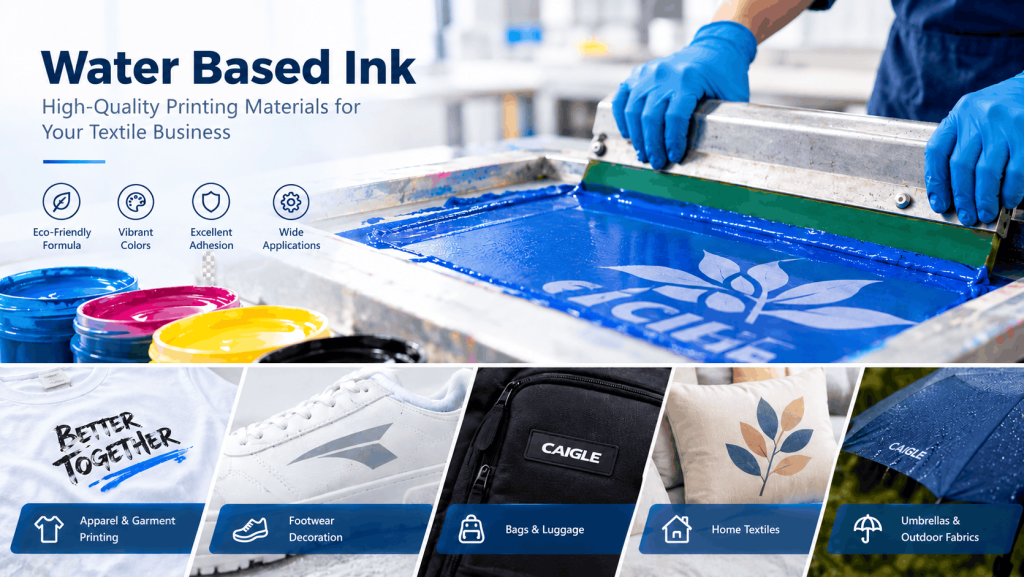
The textile printing industry serves a wide range of manufacturing sectors, from garment production and footwear decoration to luggage, home textiles, and outdoor fabric products. As brands introduce more designs and manufacturers manage increasingly diverse orders, choosing suitable printing materials has become an important part of maintaining product quality and production efficiency.
For screen printing factories, digital printing companies, garment manufacturers, and material distributors, the most important consideration is not simply the name of a material. It is whether the formulation matches the substrate, printing equipment, finished-product requirements, and manufacturing workflow.
Different printing processes create different material requirements. A screen printing paste may need suitable application characteristics for the selected mesh and printing method, while digital textile printing materials must be compatible with the relevant equipment and ink delivery system. Shoe materials and coated fabrics may require additional attention to adhesion and surface preparation.
Caigle develops and supplies textile printing materials, including printing paste, digital coating ink, silicone materials, and shoe materials. This guide explains how B2B buyers can evaluate Water Based Inl-related solutions, improve material selection, and establish a productive relationship with a printing material supplier.
What Is Water Based Inl?
Water Based Inl refers to a water-based textile printing material in the context of this article. The term should be understood as a target search phrase rather than a universal technical classification covering every water-based ink, paste, or coating.
Water-based textile printing materials are developed for different applications and manufacturing processes. Depending on the product category, they may be used to print graphics, logos, lettering, decorative patterns, and other designs on suitable textile surfaces.
Their actual characteristics depend on the formulation and intended use. Relevant factors may include viscosity, color development, substrate compatibility, application method, drying or curing requirements, flexibility, and adhesion.
For professional buyers, identifying the correct product category is the first step. Screen printing paste, digital printing ink, digital pretreatment materials, silicone printing materials, and shoe decoration materials serve different purposes. They should not be treated as interchangeable simply because they may all be associated with textile printing.
Businesses evaluating Water Based Inl should therefore communicate the intended process and finished product clearly before requesting samples or quotations.
Why Water Based Inl Matters to B2B Printing Businesses
Supporting Consistent Production
Printing factories often handle repeated production orders for multiple customers. Variations in material characteristics, fabric composition, or processing conditions can affect the final appearance and quality of printed products.
Selecting a suitable material and establishing consistent operating procedures can help manufacturers reduce avoidable production variation. Material evaluation should include the actual fabric, printing equipment, and processing conditions rather than relying solely on a product description.
For purchasing teams, this also means comparing materials according to application suitability and production results, not only their purchase price.
Meeting Different Fabric and Design Requirements
A printing factory may work with cotton, polyester, blended fabrics, elastic textiles, and selected coated materials. These substrates do not necessarily respond to the same printing formulation in the same way.
The design itself also affects material selection. Fine details, large printed areas, specific color requirements, and flexible graphics can create different technical demands.
Before selecting Water Based Inl, manufacturers should define the substrate, required visual effect, and intended use of the finished product. These details help suppliers identify relevant material options for further testing.
Supporting More Flexible Customer Cooperation
For distributors, importers, and textile material brands, a reliable supplier relationship extends beyond individual orders. Product consistency, technical communication, customization discussions, and supply planning all influence long-term cooperation.
A manufacturer that understands the application can help buyers evaluate alternative material categories and clarify what needs to be tested before commercial production.
Caigle’s official product portfolio includes printing paste, digital coating ink, silicone, and shoe materials, giving B2B buyers several product categories to explore according to their needs.
Water Based Inl for Different Printing and Manufacturing Applications
Screen Printing Factories
Screen printing remains relevant to garment decoration, logos, lettering, and various textile graphics. In this process, material selection should account for the substrate, design, desired print appearance, and equipment configuration.
For screen printing factories, useful evaluation criteria include application consistency, print definition, hand feel, adhesion, and performance after the finished product undergoes its intended use conditions.
Caigle’s Water-Based Textile Printing Paste guide provides additional information about printing paste and its role in professional garment printing.
Digital Textile Printing Companies
Digital textile printing introduces different requirements because the material must work with the relevant printing technology and equipment. Depending on the production system, manufacturers may need to evaluate ink compatibility, printhead requirements, fabric pretreatment, color reproduction, and processing conditions.
Buyers should confirm the exact ink category and equipment compatibility before placing an order. A water-based formulation designed for one digital printing process should not automatically be assumed suitable for another.
Caigle offers a Digital Coating Ink Series, which buyers can explore when investigating materials for digital textile production.
Garment Factories and Apparel Brands
Garment factories need printing materials that fit the fabric and the expectations of the final product. Printed areas may be expected to remain visually consistent while accommodating normal wear, movement, and laundering.
The required balance depends on the garment. A decorative design on a casual T-shirt may have different requirements from a graphic on stretch sportswear or a workwear product.
Manufacturers should evaluate the material on the actual garment fabric and use relevant tests to assess adhesion, flexibility, washing performance, and the finished surface.
Shoe Material Manufacturers
Footwear production involves multiple substrates, surface treatments, and decorative processes. A material that performs well on a textile upper may not necessarily work on synthetic leather or another treated surface.
For shoe material factories, application-specific testing is essential. Important considerations may include surface preparation, adhesion, abrasion exposure, flexibility, and compatibility with subsequent manufacturing steps.
Caigle’s Shoe Materials Series is a relevant starting point for businesses evaluating materials for footwear decoration and related applications.
Luggage, Home Textiles, and Umbrella Fabric Producers
Printing materials are also used in luggage, bedding, decorative fabrics, and umbrella-related textile applications. These products can face different conditions during handling and use.
For example, a printed design on a bag may experience repeated friction, while an umbrella fabric may require evaluation under its intended moisture and outdoor exposure conditions. Home textile applications may place greater emphasis on washing, appearance retention, or fabric feel.
Buyers should explain the finished product’s intended use instead of requesting a material based only on a broad substrate category.
How to Select the Right Water Based Inl Solution
1. Identify the Substrate
Start by specifying the fabric or surface that will receive the print. Provide the material composition and any relevant information about existing coatings, pretreatments, or surface treatments.
If the project involves an unfamiliar substrate, send a representative sample when possible. Testing the material on the actual production surface is more informative than relying on a general compatibility statement.
2. Confirm the Printing Process
Clearly identify whether the application involves screen printing, digital textile printing, transfer decoration, or another process. Each method has its own material and equipment requirements.
For digital printing, confirm the intended ink category and equipment compatibility. For screen printing, discuss the required application characteristics and the production conditions with the supplier.
3. Define the Finished-Product Requirements
Describe the required color appearance, pattern definition, surface texture, and hand feel. Depending on the application, the finished product may also need to withstand washing, friction, stretching, bending, or moisture exposure.
These requirements should be established before the material is approved. They provide a clear basis for sample evaluation and reduce the risk of choosing a product that meets the visual brief but fails during use.
4. Test Processing Conditions
Material performance depends on the complete printing process. Application settings, drying or curing conditions, substrate preparation, and equipment configuration can all affect the result.
Follow the supplier’s technical instructions and conduct controlled trials using representative production conditions. Record the process settings and results so that approved samples can be reproduced more consistently.
5. Evaluate Supply and Customization Needs
B2B buyers should also consider the commercial side of material selection. Relevant factors include order volume, delivery requirements, packaging, technical communication, and the ability to discuss customized formulations.
If standard materials do not meet the application requirements, explain the gap to the supplier. Custom development may be worth discussing, but the feasibility, development schedule, and validation requirements should be confirmed for each project.
Common Water Based Inl Challenges and Practical Checks
Inconsistent Color or Print Appearance
Color variation can arise from differences in the material, substrate, equipment settings, or processing conditions. Use approved samples and consistent inspection procedures to compare production results.
When a variation occurs, review the entire process before changing several settings at once. Controlled adjustments make it easier to identify the cause.
Poor Adhesion or Washing Performance
Peeling or loss of print appearance may indicate that the material is unsuitable for the substrate or that the processing conditions require adjustment.
Review substrate preparation, material compatibility, and the recommended drying or curing process. Select appropriate tests based on the intended use of the finished product.
Cracking on Flexible Fabrics
Printed graphics on elastic textiles may be exposed to repeated stretching. If the material and printing construction cannot accommodate the required movement, the design may crack or lose its intended appearance.
Evaluate the complete printed construction on the actual fabric. Do not assume that results on a rigid test surface will predict performance on a stretch garment.
Production Delays Caused by Material Mismatch
A material that is incompatible with the existing equipment or production workflow can lead to repeated trials and unnecessary downtime.
Before ordering at scale, confirm the intended application, equipment requirements, sample approval process, and technical support arrangements. This is particularly important for overseas buyers who may need to coordinate between a material supplier and a separate manufacturing facility.
Why Consider Caigle as Your Textile Printing Material Supplier?
Guangdong Caigle Science & Technology Co., Ltd. focuses on the development and manufacturing of textile printing materials. Its official website presents product categories including printing paste, digital coating ink, silicone materials, and shoe materials.
The company identifies garments, shoes, luggage, umbrellas, bedding, and decorative fabrics among its application areas. This product and application coverage gives manufacturers and distributors a starting point for discussing different textile printing requirements.
For buyers evaluating Water Based Inl, the most useful approach is to share the specific application and confirm which existing product category is appropriate. A broad keyword alone does not establish that a particular formulation is suitable for every printing process.
When contacting Caigle, prepare the following information:
- Substrate type and composition.
- Printing process and equipment model, where relevant.
- Required print appearance and performance.
- Expected order volume and purchasing schedule.
- Any sample, packaging, or customization requirements.
Clear technical information helps both parties assess the project more efficiently and determine whether further sample testing or customization is needed.
Visit the Caigle website to explore its product categories, or use the Contact Us page to discuss your application with the company.
Frequently Asked Questions (FAQ)
What is Water Based Inl used for?
In this article, Water Based Inl refers to water-based textile printing materials considered for professional printing applications. The appropriate product depends on the intended printing process, substrate, and finished-product requirements.
Is Water Based Inl suitable for screen printing and digital printing?
Not every water-based material is suitable for both processes. Screen printing paste and digital printing ink have different application and equipment requirements. Confirm the product category and compatibility with the supplier before production.
Can Water Based Inl be used for footwear and luggage materials?
Potentially, depending on the specific formulation and substrate. Footwear and luggage materials may have different surface treatments and performance requirements, so application testing is recommended before mass production.
What should buyers test before placing a bulk order?
Buyers should evaluate the required print appearance, adhesion, relevant durability characteristics, substrate compatibility, and processing conditions. The test plan should reflect the intended use of the finished product.
Can Caigle discuss customized textile printing materials?
Caigle’s website presents multiple textile printing material categories and discusses customized solutions in its published product information. Buyers should contact the company to confirm feasibility, technical requirements, and commercial terms for a particular project.
What information is needed to request a quotation from Caigle?
Provide the substrate, printing method, intended application, required performance, estimated order quantity, and delivery requirements. Samples or technical documents can help clarify the project.
Conclusion
Water Based Inl is the target keyword for buyers researching water-based materials for textile printing and related manufacturing applications. However, selecting a suitable solution requires a clear understanding of the substrate, printing process, equipment, finished-product requirements, and production conditions.
For screen printing factories, digital printing companies, garment manufacturers, footwear producers, and overseas material distributors, a structured evaluation process can reduce material mismatch and support more predictable production. Testing the complete material system before mass production is an important part of that process.
Caigle offers several textile printing material categories, including printing paste, digital coating ink, silicone materials, and shoe materials. By explaining your application and technical requirements, you can begin a more focused discussion about suitable products and potential long-term cooperation.
Looking for a textile printing material supplier for your next project? Contact Caigle to discuss your application, request product information, and explore customized material solutions for your business.