
Introduction: Why Matte Top Coating Matters in B2B Manufacturing
In footwear, apparel, and textile decoration, surface finishing influences how a product looks, feels, and performs during everyday use. As brands develop more distinctive product designs, manufacturers need finishing solutions that complement the original artwork while meeting the practical requirements of production. Matte Top Coating is an important finishing concept for businesses seeking a refined, low-gloss appearance on selected printed and decorated surfaces.
Unlike a highly reflective finish, a matte surface diffuses reflected light to create a more understated visual effect. This appearance can be suitable for footwear logos, decorative labels, printed graphics, and selected branding components. However, a successful finish depends on more than its visual characteristics. Material compatibility, adhesion, flexibility, processing conditions, and consistency must also be evaluated.
For B2B buyers, selecting a suitable coating involves balancing design requirements with manufacturing efficiency and finished-product expectations. A material that performs well on one substrate may not produce the same result on another, even when the application looks similar.
Caigle provides textile printing materials and silicone-related solutions for professional manufacturing applications. This guide explains how manufacturers can assess Matte Top Coating requirements, compare finishing options, identify potential production problems, and prepare for supplier discussions.
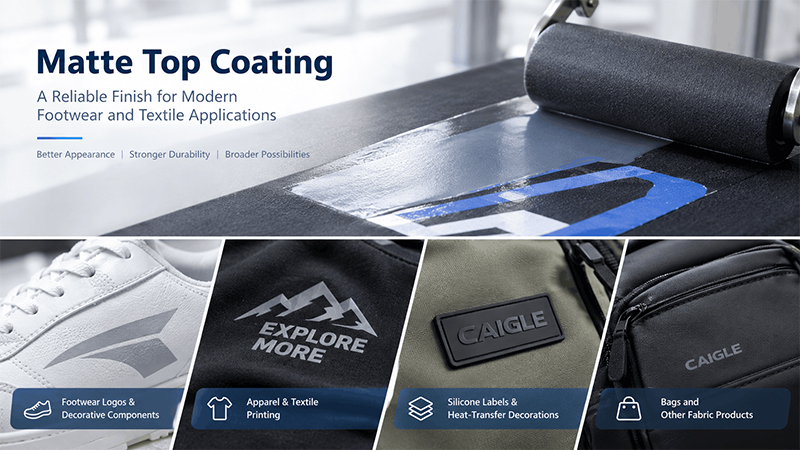
What Is Matte Top Coating?
Matte Top Coating generally describes a finishing layer designed to produce a low-gloss or non-reflective surface on a printed or decorated product. Depending on the material system, it may be used to modify the final appearance of a graphic, label, logo, or other decorative element.
The term describes a finishing function rather than one universal chemical composition. Different formulations can have different application methods, curing requirements, adhesion characteristics, and compatibility limitations. Buyers should therefore confirm the actual material specification instead of assuming that every matte coating works in the same way.
In footwear decoration, a matte finish may be considered for printed logos, silicone labels, transfer graphics, and selected decorative components. In textile printing, manufacturers may seek a similar appearance for garment graphics and branded details.
It is also important to distinguish Matte Top Coating from Matte Silicone. Matte Top Coating refers to a finishing function, whereas Matte Silicone describes a silicone-based material used to create a particular surface effect. The two may be relevant to related applications, but they are not automatically interchangeable.
For more information about silicone-based finishing materials, explore Caigle’s Matte Silicone article.
Key Benefits and Selection Considerations for Matte Top Coating
1. A Refined, Low-Gloss Surface Appearance
One of the main reasons manufacturers consider a matte finish is its visual character. By reducing strong surface reflections, a matte effect can create a restrained appearance that complements minimalist designs, understated branding, and products that do not require a bright, glossy highlight.
For footwear manufacturers, this effect may be appropriate for logos, labels, and decorative details that need to coordinate with textured or low-gloss materials. Apparel brands may also consider matte finishes when developing a consistent visual identity across different garments and accessories.
The actual appearance depends on the substrate, underlying print, coating formulation, application thickness, and processing conditions. Buyers should evaluate the complete construction under consistent lighting rather than judging a material solely from photographs.
2. Compatibility with the Existing Material System
A finishing layer must work with the surface beneath it. Fabric composition, substrate texture, surface treatments, and the chemistry of the existing print can all influence the final result.
For example, a coating intended for a silicone-based decoration should not automatically be assumed suitable for every synthetic leather, textile, or transfer film. Compatibility should be confirmed through technical documentation and practical trials.
Before requesting samples, identify the substrate and the material already used to create the printed design. Sharing these details with the supplier can help narrow the selection and avoid unnecessary production experiments.
3. Functional Performance for the Intended Application
A decorative surface may encounter friction, bending, stretching, moisture, washing, or repeated handling during use. The required performance therefore depends on the finished product and its expected service conditions.
For flexible footwear components, manufacturers may need to evaluate whether the finishing layer remains intact during repeated bending. For apparel graphics, wash resistance and compatibility with fabric movement may be more important.
These properties should be treated as requirements to verify rather than guaranteed characteristics of every Matte Top Coating product. Establishing clear acceptance criteria before production helps buyers make more reliable purchasing decisions.
Where Can Matte Top Coating Be Considered?
Footwear Logos and Decorative Components
Footwear is a relevant application area for matte surface effects because logos and decorative components often combine several materials and finishing processes. A low-gloss finish may complement sports shoes, casual footwear, and fashion designs that require a more understated appearance.
Potential applications include shoe logos, labels, decorative graphics, and selected transfer components. However, each application requires an assessment of substrate compatibility, adhesion, flexibility, and abrasion exposure.
Manufacturers should test the complete decorated component under conditions that represent actual product use. The presence of a matte finish alone does not establish suitability for every footwear construction.
Silicone Labels and Heat-Transfer Decorations
Silicone-based transfer decorations allow manufacturers to create branded graphics separately before applying them to suitable textile products. Depending on the design and material system, these decorations can incorporate different surface effects, including matte finishes.
The selection process should consider the transfer material, target fabric, application equipment, and required processing conditions. Temperature, pressure, and transfer time should follow the applicable technical instructions and be verified during sample development.
Caigle’s Silicone Transfer Label Series provides additional information about transfer decoration and the factors that influence material selection.
Apparel and Textile Printing
For apparel manufacturers, matte effects may be considered for logos, lettering, graphic details, and branded decorations. The suitability of a particular finishing material depends on whether it is intended for direct printing, transfer applications, or another production method.
Stretch fabrics introduce additional considerations because the printed construction may need to accommodate repeated deformation. Garments also have different washing and wear requirements depending on their intended use.
Before scaling up, manufacturers should test representative fabric samples and inspect the finish after the relevant performance tests.
Bags and Fashion Accessories
Bags, caps, and other textile accessories may incorporate printed or transferred branding elements with low-gloss surface effects. These products vary considerably in material composition, surface treatment, and exposure to abrasion.
A solution that works on a woven fabric may behave differently on a coated or synthetic surface. Consequently, buyers should specify the exact substrate and evaluate the finished decoration in the context of the intended product.
How to Select the Right Matte Top Coating
Step 1: Define the Required Surface Effect
Start by explaining what the finished product should look and feel like. Terms such as matte, smooth, soft-touch, and low-gloss may be interpreted differently by different suppliers.
A physical reference sample is particularly useful when the project requires a specific appearance. If no reference is available, document the desired visual effect and agree on how the sample will be evaluated.
Where appropriate, compare the proposed finish with a glossy alternative to confirm that the selected surface meets the design brief.
Step 2: Identify the Substrate and Application Method
Provide the supplier with information about the substrate, existing decorative layer, and intended application method. Relevant details may include fabric composition, whether the decoration is silicone-based, and whether the process involves direct printing or heat transfer.
These details help determine which materials warrant testing. They also reduce the risk of choosing a product based on appearance alone.
Do not assume that a coating used in one application can be transferred directly to another substrate without validation.
Step 3: Establish Performance Requirements
List the conditions the finished product must withstand. Depending on the application, these may include adhesion, abrasion, repeated bending, stretching, washing, or moisture exposure.
Choose tests that reflect the intended use rather than applying an identical test plan to every product category. For example, a stretch garment and a rigid decorative component may require different evaluation methods.
Agree on acceptance criteria before comparing samples. This gives purchasing, quality, and production teams a shared basis for approval.
Step 4: Confirm Processing Conditions
Application and curing conditions can influence surface appearance and final performance. Buyers should request the appropriate technical instructions for the selected material and confirm whether the existing equipment and production workflow are suitable.
During trial production, record relevant process settings and inspect the finished samples. Changes in equipment, substrate, or processing conditions should be evaluated before they are introduced into routine manufacturing.
Step 5: Evaluate Repeatability and Total Cost
The lowest material price does not necessarily result in the lowest production cost. Rejected products, repeated trials, material waste, and additional inspection can increase the total cost of a finishing process.
B2B buyers should compare suppliers based on material suitability, technical support, process compatibility, consistency, and overall production requirements.
A documented sample approval process can also help reduce misunderstandings between the buyer, material supplier, and factory responsible for application.
Common Matte Top Coating Problems and Quality Checks
Uneven Matte Appearance
Differences in surface preparation, application thickness, substrate texture, and processing conditions can lead to inconsistent appearance. Inspect the complete process before making changes to the material.
Use approved samples and consistent lighting when assessing gloss and surface uniformity. This helps ensure that different inspectors evaluate the product against the same standard.
Poor Adhesion or Peeling
Peeling may indicate an incompatibility between the coating and substrate, inadequate surface preparation, or unsuitable processing conditions.
Review the material combination and process instructions, then conduct controlled trials to identify the cause. Do not assume that adding more material will resolve an adhesion issue.
Cracking During Flexing
Cracking can occur when a finishing system is not suitable for the movement of the underlying material or when processing affects the finished layer.
For flexible textiles and footwear components, evaluate the complete construction through representative bending or stretching tests. Select a material based on the actual application requirements rather than its surface appearance alone.
Unexpected Surface Feel
A finish may look correct but feel different from the approved sample. Application thickness, the underlying print layer, and the material formulation can influence the tactile result.
Define the expected hand feel during sample approval and evaluate it alongside appearance and functional performance. This is especially useful when several production teams are involved in the same project.
Why Consider Caigle for Matte Finishing Applications?
Caigle’s official website presents a portfolio of textile printing materials and silicone-related solutions serving manufacturing applications. Its published content covers matte silicone, silicone transfer labels, and other printing materials that may be relevant to buyers evaluating decorative surface effects.
For manufacturers investigating Matte Top Coating, the appropriate starting point is to explain the intended application and confirm which available material best fits the project. The finishing terminology used by a buyer does not necessarily correspond to a standalone product name or a universally applicable formulation.
When contacting Caigle, consider providing the following information:
- The substrate and existing print or decoration layer.
- The desired matte appearance and tactile characteristics.
- The application method and available production equipment.
- The required durability and quality acceptance criteria.
- The intended order quantity and any sample requirements.
This information allows the supplier to understand the project more clearly and advise on suitable materials and validation steps.
You can explore Caigle’s Matte Silicone information and Silicone Transfer Label Series for related application guidance.
Frequently Asked Questions (FAQ)
What is Matte Top Coating used for?
Matte Top Coating generally describes a finishing layer intended to create a low-gloss surface on selected printed or decorated products. Its suitability depends on the formulation, substrate, application method, and required performance.
What is the difference between Matte Top Coating and Matte Silicone?
Matte Top Coating describes a finishing function, while Matte Silicone refers to a silicone-based material associated with matte surface effects. A specific application may use a silicone material to achieve a matte finish, but the terms should not be treated as identical in every case.
Can Matte Top Coating be used for footwear decoration?
It may be suitable for selected footwear applications, depending on the material system and substrate. Manufacturers should verify compatibility and test adhesion, flexibility, abrasion performance, and appearance before mass production.
Is Matte Top Coating suitable for textile printing?
Suitability depends on the formulation, fabric, and printing or transfer process. Buyers should confirm the intended application with the supplier and test the complete material system on representative fabric samples.
How can manufacturers check matte finish quality?
Inspect appearance, surface uniformity, adhesion, and any application-specific performance requirements. Use consistent lighting, approved reference samples, documented test methods, and agreed acceptance criteria.
What information should I provide when requesting a quotation?
Share the substrate, application method, desired surface effect, performance requirements, estimated quantity, and relevant production conditions. Reference samples or photographs can help clarify the required result.
Does Caigle offer a product specifically named Matte Top Coating?
Caigle publishes information about Matte Top Coating and Matte Silicone-related applications. However, the exact product name, current availability, and applicable technical specifications should be confirmed directly with the company before ordering.
Conclusion
Matte Top Coating can help manufacturers achieve a refined, low-gloss appearance on selected footwear, textile, and decorative applications. However, selecting a suitable finishing solution requires more than matching a visual effect. Substrate compatibility, adhesion, flexibility, processing conditions, and repeatable quality must all be considered.
For B2B buyers, a structured selection process helps reduce production uncertainty. Define the required appearance, identify the complete material system, test representative samples, and establish clear acceptance criteria before approving a material for larger-scale production.
Caigle’s published range of textile printing and silicone-related materials provides a starting point for businesses exploring matte finishing applications. Confirming the exact product and its suitability with the supplier is the next step toward a reliable manufacturing solution.
Looking for a matte finishing solution for your footwear or textile production project? Contact Caigle to discuss your application, share your technical requirements, and explore suitable material options for your business.