
Digital textile printing gives garment manufacturers and textile printing factories greater flexibility when producing detailed graphics, colorful patterns, customized apparel, and short production runs. However, print quality depends on more than the printer and ink. The condition of the fabric before printing can also influence color appearance, image definition, ink interaction, and the consistency of the finished product.
A Digital Pretreatment Solution is an important part of many digital textile printing workflows. It is used to prepare a suitable fabric surface for subsequent printing, helping manufacturers manage the interaction between the textile, pretreatment material, and ink system.
For screen and digital printing factories, garment manufacturers, footwear producers, luggage and umbrella fabric processors, and home textile companies, selecting an appropriate pretreatment material requires careful consideration of the substrate and intended application. A solution that performs well on one fabric or printing system may not deliver the same result on another.
Caigle develops textile printing materials for different production needs, including digital inks, digital printing pastes, and pretreatment materials. Its digital textile printing ink solutions provide additional context for understanding how pretreatment fits into the wider printing process.
This guide explains what a Digital Pretreatment Solution does, why it matters, how to evaluate compatibility, and which production factors manufacturers should consider before selecting a product.
1. What Is a Digital Pretreatment Solution?
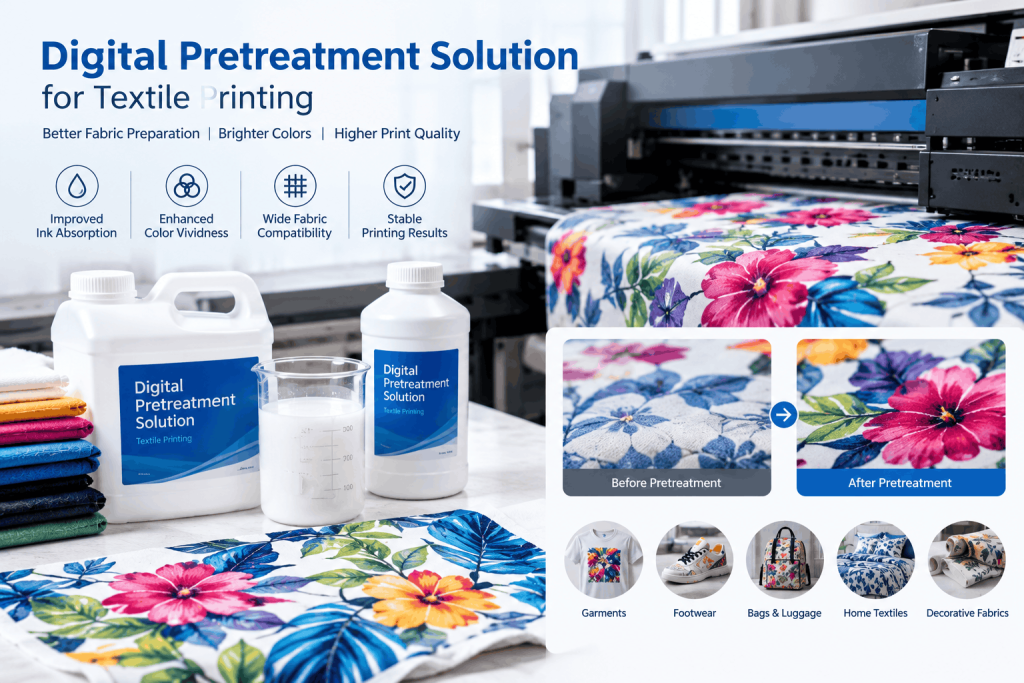
A Digital Pretreatment Solution is a material applied before a digital printing stage to prepare the textile surface for a particular printing process. Depending on the formulation and application, pretreatment can influence how ink interacts with fabric fibers and how the printed image develops during production.
Pretreatment is not a universal requirement for every digital printing method or every fabric. Its role depends on the printer, ink chemistry, textile composition, print design, and required finish.
For example, direct-to-garment printing on dark apparel may require a different preparation process from printing a pattern on a light-colored fabric. Likewise, a cotton garment and a polyester sportswear fabric may respond differently to the same treatment.
The purpose is therefore not simply to apply an additional chemical layer. It is to establish a more suitable and consistent starting point for the printing process.
How Pretreatment Fits into Digital Printing
A typical workflow may include the following stages:
Identify and inspect the fabric.
Prepare the textile or garment according to the printing system’s requirements.
Apply the compatible Digital Pretreatment Solution, if required.
Dry or otherwise process the treated material according to the product instructions.
Print the artwork using the compatible ink system.
Complete the specified drying, curing, or finishing process.
Inspect the finished print for appearance and durability.
The exact sequence varies by printing technology and product. Manufacturers should follow the technical instructions for the selected material rather than treating this general workflow as a universal recipe.
Digital Pretreatment and Printing Ink Work Together
Pretreatment and ink should be evaluated as parts of one printing system. Ink that produces satisfactory results on untreated fabric may behave differently after a surface treatment is applied. Conversely, a pretreatment selected without considering the ink may fail to deliver the expected print appearance.
Caigle’s DTG Ink for direct-to-garment printing article discusses the relationship between pretreatment, fabric preparation, ink application, and curing. It is a useful related resource when evaluating the complete workflow.
2. Why Is a Digital Pretreatment Solution Important?
A suitable Digital Pretreatment Solution can help manufacturers manage several aspects of digital textile printing. The outcome depends on the specific product and the compatibility of the entire process.
Supporting Color Appearance
Color appearance is one of the most visible indicators of print quality. Differences in fabric absorbency, surface structure, and ink interaction can influence the appearance of the same digital artwork on different textiles.
Appropriate pretreatment may help establish more consistent conditions for ink application. This is especially important when a factory needs to reproduce similar designs across multiple garments or production batches.
However, pretreatment alone cannot guarantee accurate color. Printer calibration, ink selection, fabric color, artwork preparation, and curing conditions also influence the result.
Helping Improve Image Definition
Fine lines, small text, gradients, and detailed patterns can be challenging to reproduce consistently across different substrates.
When the pretreatment is compatible with the printing system, it may help manage how the ink interacts with the fabric surface. Manufacturers should evaluate the printed image for edge definition, unwanted spreading, uneven areas, and other visible defects.
Testing the actual production fabric is more useful than relying exclusively on results obtained from a different sample material.
Managing White Ink on Dark Garments
White ink is often used when printing colorful designs on dark or colored garments. In these applications, the white base can influence the visibility and contrast of the colors printed above it.
A suitable pretreatment may support the intended white-ink printing process, but results depend on the complete system, including the fabric, ink, application method, and curing conditions.
For applications specifically focused on white ink, see Caigle’s article on White Ink Direct Injection Treatment Liquid. That page should remain the primary resource for the narrower white-ink treatment topic, while this guide addresses general pretreatment selection.
Supporting More Consistent Production
In commercial textile printing, a good result on one sample is not enough. Manufacturers need repeatable performance across garments, fabric lots, operators, and production shifts.
A consistent pretreatment process can help reduce variation caused by uneven application or inconsistent preparation. The factory should monitor material quantity, coverage, drying, and the condition of the fabric before printing.
The objective is a repeatable process that meets the customer’s visual and functional requirements—not simply a good-looking first print.
3. Choosing a Digital Pretreatment Solution for Different Fabrics
Fabric compatibility is one of the most important factors when selecting a Digital Pretreatment Solution. The same product should not automatically be assumed suitable for every fiber, fabric construction, or printing system.
Cotton and Cotton-Rich Garments
Cotton T-shirts, sweatshirts, hoodies, and other cotton-rich garments are common products in digital garment printing.
When selecting pretreatment for these materials, manufacturers should consider the fabric’s absorbency, surface condition, color, and intended printing method. Garment preparation should also be consistent, because contamination, loose fibers, or uneven surfaces can affect the finished image.
A practical evaluation should include print appearance, hand feel, and the durability requirements relevant to the garment’s intended use.
Polyester and Synthetic Fabrics
Polyester is widely used in sportswear, uniforms, bags, and other textile products. Its surface characteristics and dye behavior differ from those of cotton, so the same pretreatment process may not be appropriate for both materials.
For synthetic fabrics, confirm that the proposed treatment is compatible with the textile and ink system. If the fabric is dyed, coated, or finished, those additional characteristics should also be considered.
Where dye migration is a concern, do not assume that a general Digital Pretreatment Solution will solve the problem. The application may require a more specific treatment system and separate testing.
Blended and Stretch Fabrics
Cotton-polyester blends, elastane blends, and other mixed-fiber textiles can present additional challenges because their components may interact differently with printing materials.
For stretch garments, evaluate whether the printed area remains acceptable when the fabric is extended and returned to its original shape. Inspect the print for cracking, peeling, distortion, or changes in surface appearance.
The best selection process starts with the exact fabric used in production, not simply the broad category printed on a supplier’s label.
4. Digital Pretreatment Applications Across Textile Industries
A Digital Pretreatment Solution may be considered for several textile printing applications when it is compatible with the printing technology and material.
Garment and Apparel Manufacturing
Apparel factories produce fashion garments, promotional clothing, customized T-shirts, uniforms, and other printed products. Digital pretreatment can form part of the preparation process when the selected printing method requires it.
Factories should evaluate the solution against the actual garment fabric, artwork, color requirements, and expected care conditions.
Sportswear and Footwear Materials
Sportswear manufacturers often use synthetic and stretch fabrics, while footwear producers may work with different textile panels and material constructions.
These applications require careful compatibility checks because the substrate may include coatings, finishes, or blends that affect printing. Before scaling production, test the pretreatment and ink system on the specific material used in the finished product.
Bags, Umbrellas, and Decorative Fabrics
Luggage fabrics, umbrella textiles, bedding, and decorative fabrics may have different surface treatments and performance requirements from everyday garments.
For these products, manufacturers should consider the textile’s intended use, surface appearance, flexibility, and relevant durability requirements. A treatment suitable for an untreated garment fabric may not be suitable for a coated or water-resistant material.
Caigle’s textile printing applications page provides a broader overview of the garment, footwear, luggage, umbrella, bedding, and decorative fabric sectors served by its printing material portfolio.
5. How to Evaluate a Digital Pretreatment Solution
Before placing a large order, establish a repeatable sample evaluation process. This helps buyers and production teams determine whether the treatment is appropriate for their specific application.
Step 1: Confirm the Printing System
Identify the printing method, printer, ink type, and intended process sequence. Confirm that the pretreatment is recommended for the selected system.
A solution intended for one digital printing process should not be assumed suitable for every inkjet application.
Step 2: Prepare Representative Fabric Samples
Use the actual production fabric whenever possible. If the factory processes several fabric types, test each relevant material separately.
Include representative colors, fabric finishes, and garment constructions. This helps reveal compatibility issues that may not appear on a standard sample.
Step 3: Check Application and Drying
Follow the supplier’s product instructions for application, drying, and any subsequent processing. Avoid changing multiple process variables at the same time, because doing so makes the source of a performance difference harder to identify.
Record the relevant production conditions so that successful results can be reproduced.
Step 4: Inspect the Printed Result
Evaluate the finished sample for:
Color appearance and consistency.
Image definition and edge quality.
Surface uniformity and fabric hand feel.
Adhesion or other performance requirements relevant to the process.
Stretch, wash, or abrasion performance where applicable.
Use appropriate testing methods for the intended end product. Do not infer long-term durability from appearance immediately after printing.
Step 5: Validate Before Mass Production
Once a sample meets the agreed requirements, confirm that the process can be repeated under normal production conditions. A small production trial can help identify variation in fabric lots, application, or processing before the factory commits to a larger order.
6. Common Digital Pretreatment Problems and How to Address Them
Uneven Color or Surface Appearance
Uneven results may be associated with inconsistent application, fabric variation, unsuitable pretreatment, or differences in drying and curing.
Review the fabric preparation and application process first. Then compare controlled samples to determine whether a material change or process adjustment is necessary.
Poor Performance on a New Fabric
A treatment that works on one substrate may not be compatible with another. Changes in fiber composition, dye, coating, or finishing can alter the interaction between the fabric and printing materials.
Test the new fabric before production and consult the supplier if the results differ significantly from the approved sample.
Inconsistent Results Between Batches
Variation can arise from changes in the substrate, treatment application, equipment condition, or downstream processing.
Maintain process records and consistent sample inspection criteria. If the problem persists, review the complete printing system rather than assuming the pretreatment is the only cause.
7. Why Consider Caigle for Digital Pretreatment Materials?
Caigle focuses on textile printing materials, including digital printing inks, digital printing pastes, and related pretreatment products. Its portfolio allows customers to explore supporting materials alongside the ink and printing process they already use.
For textile printing factories and manufacturers, the selection process should begin with a clear description of the application. Relevant information includes fabric composition, printing method, ink type, fabric color, expected finish, and any required durability tests.
Caigle’s digital textile printing ink solutions and product range are useful starting points for reviewing related materials. Buyers can then discuss the intended application and confirm which product is appropriate.
Instead of selecting a Digital Pretreatment Solution based only on a product name, request application guidance and test the recommended material on your own fabric and printing equipment. This approach supports more informed purchasing decisions and helps establish a repeatable production process.
Conclusion
A Digital Pretreatment Solution can play an important role in digital textile printing by preparing the fabric surface for a compatible ink system. Its suitability depends on the textile, printing technology, ink, application method, and downstream processing conditions.
For garment factories, digital printing companies, footwear material producers, luggage and umbrella fabric processors, and home textile manufacturers, careful material selection and sample testing are essential. Evaluating color appearance, image definition, surface feel, and application-specific durability can help identify the right solution for a particular production workflow.
Caigle provides a range of textile printing materials, including digital inks and pretreatment products. If you are developing a new printing process or looking for a suitable treatment for your fabric, contact Caigle to discuss your application, review compatible material options, and arrange the next steps for product evaluation.
FAQ: Digital Pretreatment Solution
1. What is a Digital Pretreatment Solution used for?
It is used to prepare a textile surface before a compatible digital printing process. Depending on the formulation and application, it can influence ink interaction, print appearance, and production consistency.
2. Is pretreatment required for every digital textile printing process?
No. The requirement depends on the printing technology, ink system, fabric, and intended result. Follow the printer and material supplier’s recommendations for the specific application.
3. Can one pretreatment product be used on cotton and polyester?
Not necessarily. Cotton and polyester have different surface and fiber characteristics. Confirm compatibility with each fabric and test the complete printing process before mass production.
4. How should manufacturers test a new pretreatment material?
Use representative production fabric, follow the supplier’s instructions, and evaluate the printed result for appearance, consistency, and relevant durability requirements. Repeat the test under realistic production conditions before scaling up.
5. Where can I find related digital printing materials from Caigle?
Visit the Caigle product range or read its digital textile printing ink guide. For application-specific guidance, contact Caigle through its official website.